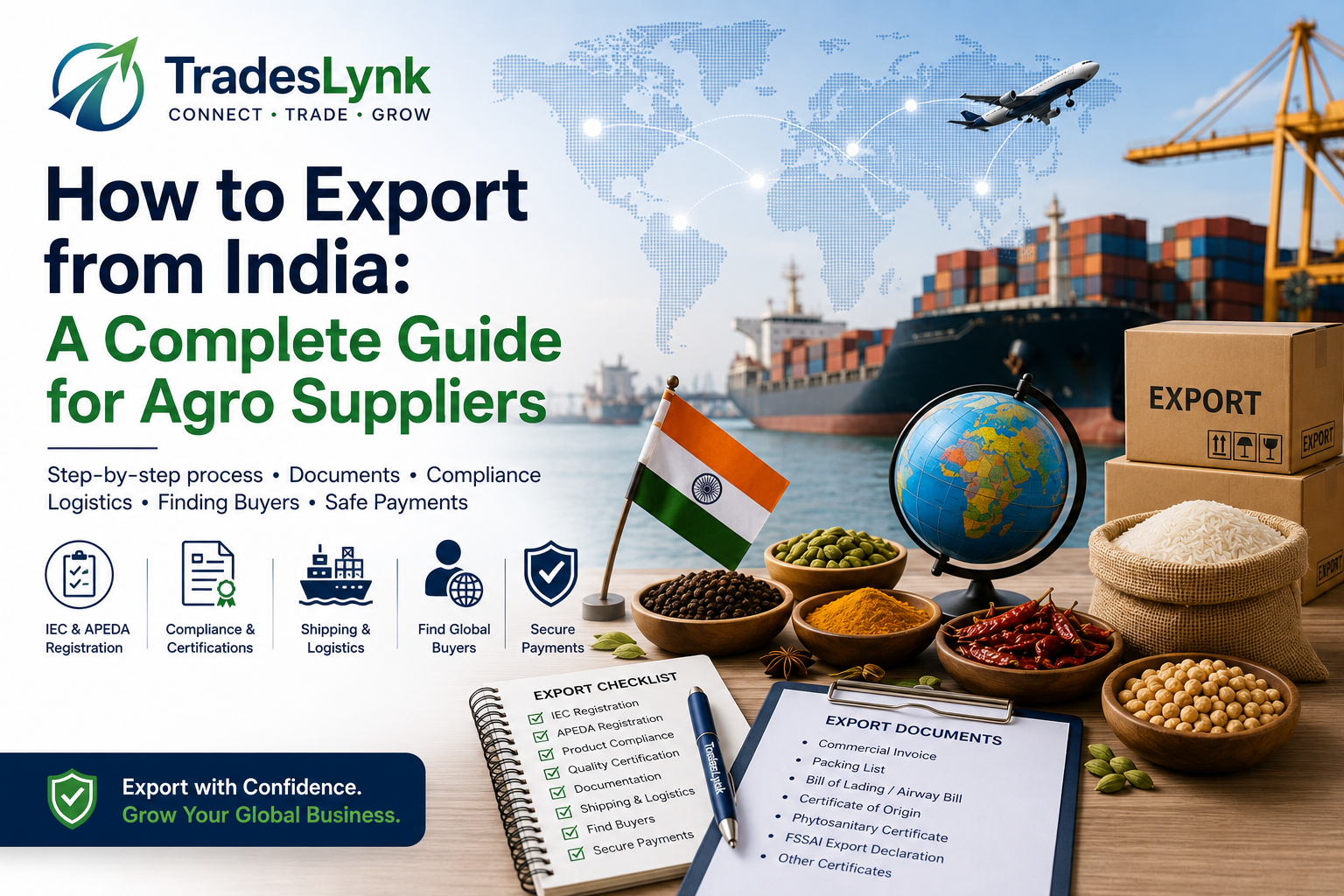
How to Export from India: A Complete Guide for Agro Suppliers
India is one of the world's largest exporters of spices, oilseeds, rice, and pulses. This step-by-step guide explains the full export process — from IEC registration to finding international buyers.
India is one of the world's top exporters of agro commodities — rice, spices, pulses, oilseeds, sugar, and processed foods. In the financial year 2024–25, agricultural exports from India exceeded $50 billion. But for a first-time exporter, the process can look complex.
This guide breaks it down into clear steps.
Step 1: Obtain your Import Export Code (IEC)
Before any export shipment leaves India, you need an Import Export Code (IEC) — a 10-digit code issued by the Directorate General of Foreign Trade (DGFT). No customs clearance is possible without it.
Step 2: Register with APEDA (for agro products)
If you are exporting any scheduled agro or processed food product (spices, fresh produce, cereals, processed foods, dairy, meat, poultry), you must register with APEDA (Agricultural and Processed Food Products Export Development Authority).
Step 3: Understand your product's export compliance requirements
Different commodities have different regulatory requirements:
Step 4: Prepare your export documentation
A typical Indian agro export shipment requires these documents:
Step 5: Choose your Incoterm and logistics partner
The most common Incoterms for Indian agro exports are:
Work with a licensed Indian freight forwarder for customs clearance at Indian ports (Chennai, Mumbai, Nhava Sheva, Mundra, Kolkata, Vizag are the main agro commodity ports).
Step 6: Get quality-tested and certified
International buyers increasingly demand third-party quality certificates. Accredited labs in India include FSSAI-notified laboratories, EIC (Export Inspection Council)-approved labs, and internationally recognised labs such as SGS India, Intertek India, and Bureau Veritas India.
Test for: moisture, aflatoxin (critical for spices and oilseeds), pesticide residues (MRL compliance for destination market), microbiological parameters, and commodity-specific adulterants.
Step 7: Find international buyers
Sources for finding overseas buyers include:
Step 8: Get paid safely
For new international buyers, insist on:
All export proceeds must be repatriated to India within 9 months under FEMA regulations.
Summary: Key agencies for Indian agro exporters
| Body | Role |
|---|---|
| DGFT | IEC issuance, export licensing |
| APEDA | Registration, certification, market development |
| Spices Board | Spice-specific certification and market development |
| EIC (Export Inspection Council) | Pre-shipment inspection and quality certification |
| FSSAI | Food safety compliance for processed foods |
| Customs (CBIC) | Customs clearance, duty drawback |
India's export incentive schemes — RoDTEP (Remission of Duties and Taxes on Exported Products) and the Interest Equalisation Scheme — provide cost offsets for eligible exporters. Consult your freight forwarder or trade consultant to claim applicable incentives.
Frequently Asked Questions
What is the first step to start exporting from India?
The first step is obtaining an Import Export Code (IEC) from the Directorate General of Foreign Trade (DGFT). Without an IEC, no export shipment can be cleared by Indian customs. The process takes 2–3 working days and costs ₹500.
Is APEDA registration mandatory to export agro products from India?
APEDA (Agricultural and Processed Food Products Export Development Authority) registration is mandatory for exporters of scheduled products including fresh fruits and vegetables, processed foods, cereals, dairy, and meat. It provides access to market development assistance and is required for APEDA-issued certificates.
What documents are needed to export agro products from India?
The core export documents are: Commercial Invoice, Packing List, Bill of Lading or Airway Bill, Certificate of Origin, Phytosanitary Certificate (for plant-based products), FSSAI export declaration, and any buyer-specific certificates such as Organic or Halal.
How do I find international buyers for Indian agro products?
Options include listing on B2B platforms like TradesLynk, attending trade fairs (AAHAR, Annapoorna), using APEDA's buyer-exporter matching portals, reaching out through commodity-specific export promotion councils (SPICES BOARD, CDB, APEDA), and running targeted digital marketing campaigns.
What is the role of a freight forwarder in India exports?
A freight forwarder manages logistics: booking cargo space, preparing shipping documents, handling customs clearance, and arranging inland transport to port. For first-time exporters, using an experienced forwarder significantly reduces the risk of documentation errors and port delays.
Explore More Topics
More from Export Guides
Next Step
Find verified exporters and turn this research into real sourcing conversations.
Related Products
Basmati Rice
Global traders ltd · India
Send InquiryPremium Yunnan Luoping Dried Ginger Slices
云南钰峻生态农业有限公司 · Canada
Send InquiryPremium Basmati Rice
ITC Limited · India
Send InquiryPremium Basmati Rice
Spice Export Co · India
Send InquiryRelated Exporters
Ready to grow your export business?
Join TradesLynk and connect with verified international buyers today.
Create Free Profile