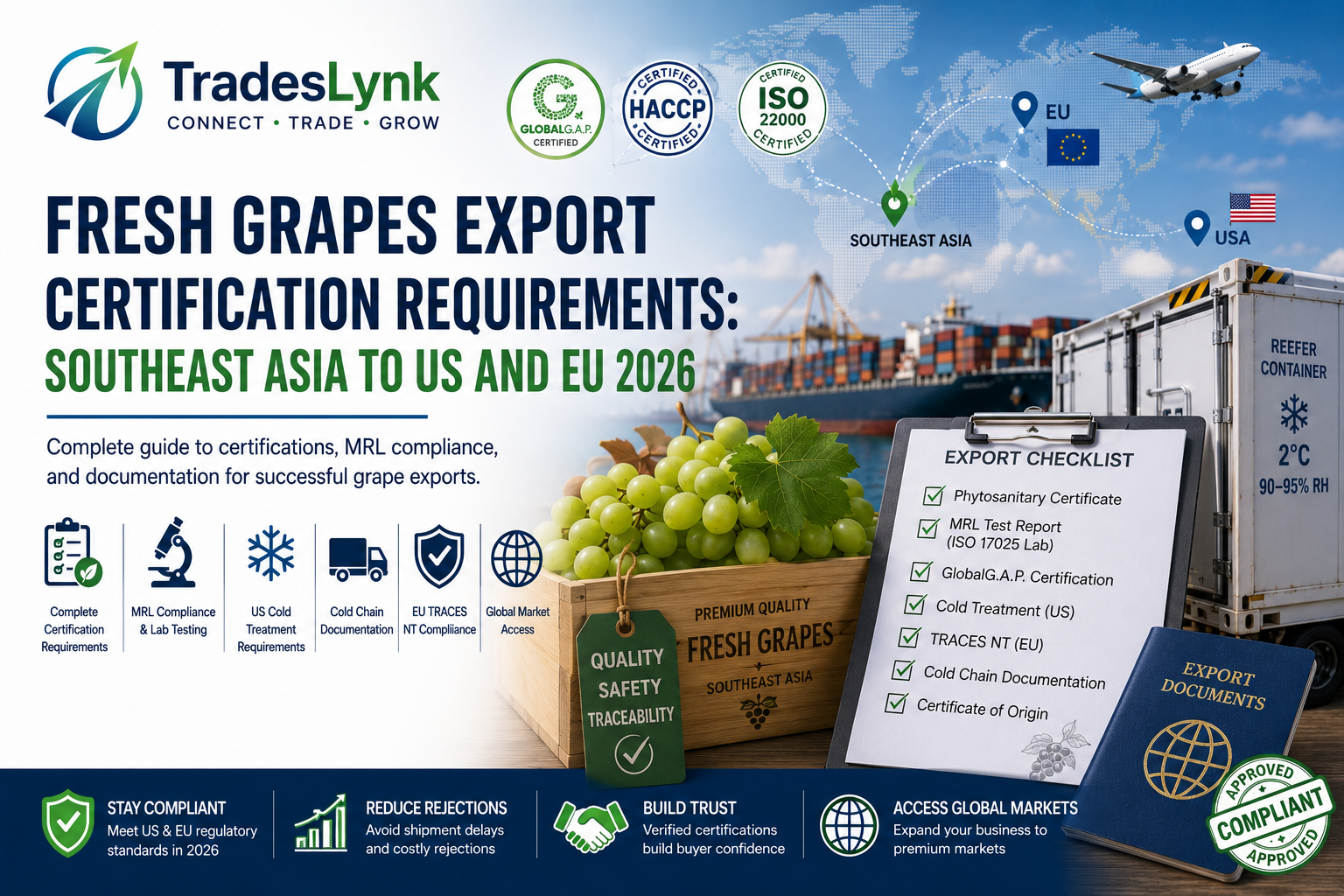
Fresh Grapes Export Certification Requirements: Southeast Asia to US and EU 2026
Exporting fresh grapes from Southeast Asia to the US or EU in 2026 requires a layered set of certifications, MRL compliance, and cold chain documentation. This guide covers every requirement.
Fresh grapes represent one of Southeast Asia's most valuable horticultural exports, with significant production in Thailand, Vietnam, and China's Yunnan province. But shipping live produce to regulated markets like the US and EU requires a layered compliance approach that goes well beyond a simple phytosanitary certificate.
This guide covers every certification and documentation requirement for fresh grape exports from Southeast Asia to the US and EU in 2026.
The regulatory gap exporters most often miss
Most Southeast Asian grape exporters understand they need a phytosanitary certificate. What many miss are:
- Destination-specific Maximum Residue Limit (MRL) compliance for each pesticide used
- US cold treatment requirements for certain pest interception categories
- EU 2026 MRL tightening that affects multiple fungicide actives commonly used in tropical viticulture
- Traceability documentation from orchard to packhouse to container
Core certifications required for both US and EU markets
1. Phytosanitary Certificate
Issued by the national plant protection organisation (NPPO) of your country. For grapes this requires:
- Pre-harvest orchard inspection by government plant health officers
- Packhouse inspection at time of packing
- Confirmation of absence of regulated pests (varies by destination country's pest risk list)
Allow 3–4 weeks lead time for scheduling inspections. Same-week issuance is rarely possible for perishable consignments without prior registration.
2. Pesticide MRL compliance certificate
This is the document most commonly flagged at EU and US borders. Requirements:
- Pre-export MRL testing by an accredited laboratory (ISO 17025 accredited)
- Full multi-residue panel matching the destination market's regulated actives list
- Testing must be on the specific lot being exported, not a generic seasonal test
EU 2026 MRL changes to be aware of: The EU tightened MRL limits for chlorpyrifos, cypermethrin, and multiple DMI fungicides used in viticulture. Southeast Asian producers must re-verify their spray programmes against the current EU Pesticides MRL database before the 2026 season.
US-specific requirements
USDA APHIS cold treatment
Grapes imported into the US from most non-NAFTA countries must undergo cold treatment to address mealybug and other interception pests. Standard cold treatment parameters: 0.56°C (33°F) or below for a minimum of 16 days. Temperature must be continuously monitored and logged throughout treatment.
- Cold treatment can be performed at origin (pre-clearance) or at a US APHIS-approved port facility
- Pre-clearance treatment at origin is strongly recommended — US port treatment adds 3–5 weeks to delivery time
- Thailand has an existing APHIS systems approach for Thompson Seedless grapes that may exempt compliant exporters from cold treatment under specific protocols
FDA Prior Notice
All food shipments to the US require FDA Prior Notice submission at least 2 hours before arrival for land/air, or 8 hours for sea. Submit via FDA's PNSI (Prior Notice System Interface) or through your customs broker.
US Importer of Record
The US importer of record bears legal responsibility for FDA compliance. Ensure your US partner has an active FDA Food Facility Registration and a documented FSVP (Foreign Supplier Verification Programme) for your facility.
EU-specific requirements
EU TRACES NT entry documentation
Fresh grapes entering the EU must be notified in advance via the TRACES NT system. A Common Health Entry Document (CHED-PP) is generated at the EU Border Inspection Post (BIP). Your EU importer must lodge pre-notification at least one working day before arrival.
GlobalG.A.P. certification
While not a legal requirement, GlobalG.A.P. certification is required by most EU retail chains. Key elements for grape producers:
- IFA (Integrated Farm Assurance) Option 1 (individual) or Option 2 (group) certification
- Specific grape module requirements covering irrigation water testing, worker welfare, pesticide storage, and harvesting hygiene
- Annual audit by a GlobalG.A.P. approved certification body
- Allow 6–9 months for first-time certification
EU Organic certification (if applicable)
For exports to the EU as organic, you need certification under a body accredited to EU Regulation 2018/848. The accredited control body must be listed on the EU's equivalence list for your country of origin. For countries not on the EU equivalence list, exporters must obtain certification from an EU-recognised control body operating in their country.
Cold chain documentation
Both the US and EU increasingly require evidence of unbroken cold chain. Prepare:
- Pre-cooling records from packhouse (target pulp temperature: 0–2°C)
- Continuous temperature logger data from packhouse to port, in container, and at destination
- Reefer container booking confirmation with set-point temperature
- Humidity control records (target 90–95% RH)
Summary certification checklist
| Certification / Document | US market | EU market |
|---|---|---|
| Phytosanitary Certificate | Required | Required |
| MRL test report (ISO 17025 lab) | Required | Required |
| Cold treatment record | Required | Not required |
| USDA APHIS systems approach compliance | If applicable | N/A |
| FDA Prior Notice | Required | N/A |
| TRACES NT pre-notification | N/A | Required |
| GlobalG.A.P. certification | Not required (buyer preference) | De facto required for retail |
| Cold chain temperature logs | Recommended | Recommended |
| Certificate of Origin | Required | Required |
For buyers sourcing fresh grapes from Southeast Asia, TradesLynk's verified exporter profiles include certification status so you can filter for GlobalG.A.P.-certified and HACCP-compliant suppliers before making contact.
Frequently Asked Questions
What certifications do I need to export fresh grapes from Southeast Asia to the US?
To export fresh grapes to the US you need: a valid Phytosanitary Certificate issued by your national plant health authority, USDA APHIS compliance (cold treatment or systems approach for key pests such as mealybug), pesticide MRL compliance under US EPA tolerances, and an FDA Food Facility Registration if applicable. GlobalG.A.P. certification is not mandatory for US market entry but is strongly preferred by US importers.
Has the EU changed grape import requirements for 2026?
Yes. Under the EU Farm to Fork strategy, several pesticide MRL limits for grapes were tightened in 2024–2025 and take effect in 2026. Key changes include stricter limits on chlorpyrifos, cypermethrin, and several fungicides. Southeast Asian exporters must ensure their spray programmes align with current EU MRL regulations (EC 396/2005 as amended). Pre-export MRL testing by an EU-recognised lab is now considered best practice.
Is GlobalG.A.P. certification required for exporting grapes to Europe?
GlobalG.A.P. certification is not a legal requirement but is a de facto market requirement for most European supermarket chains. Buyers including Tesco, Carrefour, and Albert Heijn require GlobalG.A.P. certification from all fresh produce suppliers. Without it, you are limited to non-retail channels. For most Southeast Asian grape exporters targeting EU retail, GlobalG.A.P. certification should be treated as mandatory.
What cold chain documentation is required for fresh grape exports?
Both the US and EU require evidence that the cold chain has been maintained. Required documents typically include: pre-cooling records from the packhouse, temperature logger data for the entire sea/air journey, and a reefer container booking confirmation. For US-bound shipments, cold treatment records (typically 2°C for minimum 16 days) are required for certain pest risk categories.
How long does phytosanitary certification take for fresh grapes?
Phytosanitary certification turnaround varies by country. In Thailand, Vietnam, and the Philippines, national plant health authorities typically issue certificates within 1–3 working days after field inspection and lab testing. Pre-harvest inspection scheduling should begin 3–4 weeks before the intended export date to avoid delays.
Next Step
Find verified exporters and turn this research into real sourcing conversations.
Ready to grow your export business?
Join TradesLynk and connect with verified international buyers today.
Create Free Profile