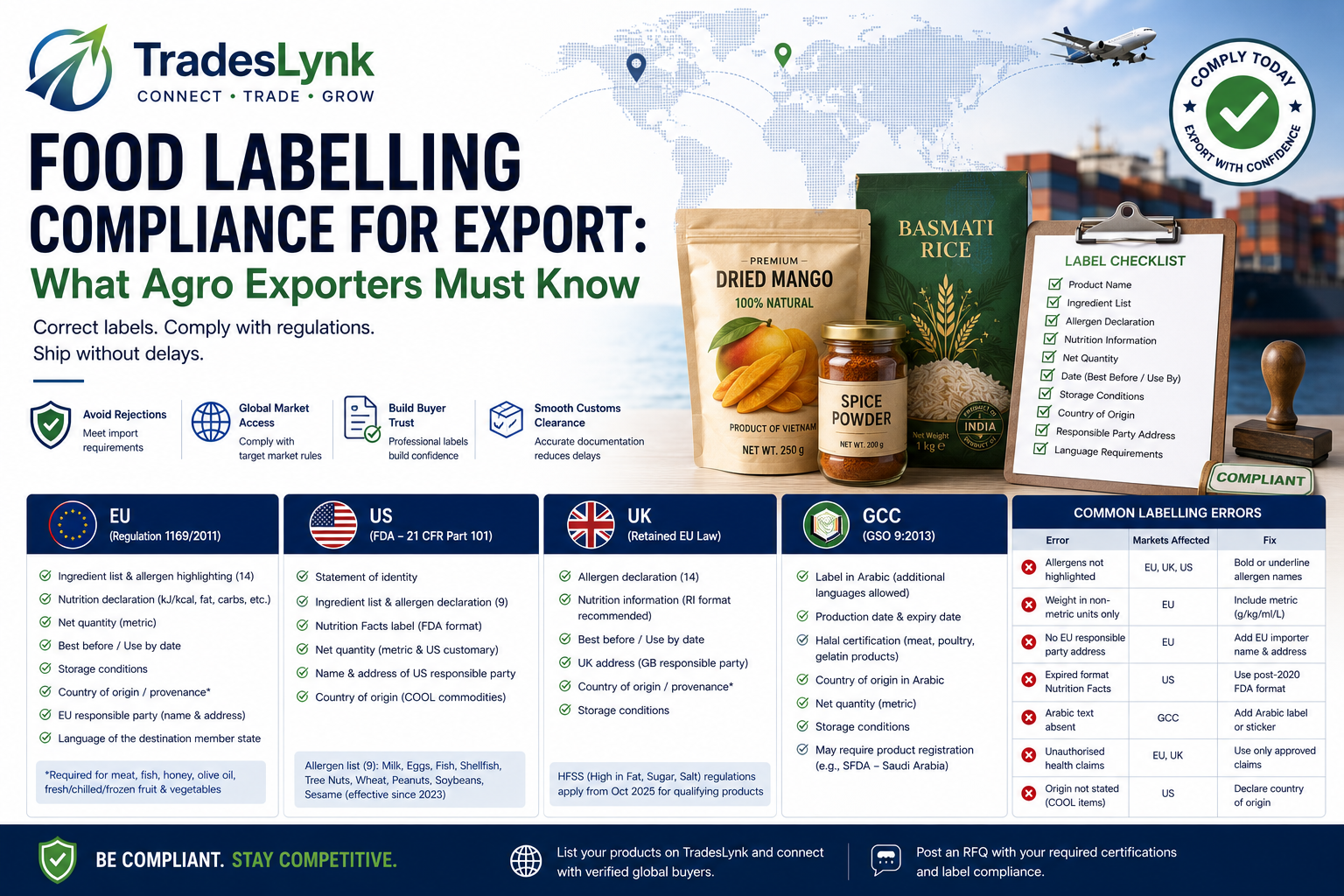
Food Labelling Compliance for Export: What Agro Exporters Must Know
Incorrect labelling is one of the most common reasons agro food shipments are rejected at customs. This guide covers the mandatory labelling fields for the EU, US, UK, and Gulf markets.
Food labelling is one of the most common reasons international agro and food shipments are rejected at border inspection — not because the product is unsafe, but because the label doesn't comply with the destination country's regulations. This guide covers the mandatory labelling requirements for the EU, US, UK, and Gulf (GCC) markets.
Why labelling rejections happen
Most labelling rejections fall into four categories:
- Missing mandatory fields (e.g. allergen declaration, nutrition information)
- Incorrect language — labels must appear in the official language(s) of the destination market
- Claims not permitted in the destination market (health claims, organic claims without recognised certification)
- Date format errors or absent storage conditions
EU food labelling requirements (Regulation 1169/2011)
The EU Food Information Regulation (FIR) 1169/2011 is the primary framework. For pre-packaged foods imported into the EU:
Mandatory fields
- Product name — legal name under EU food standards
- Ingredient list — in descending order by weight as present at manufacturing stage
- Allergen declaration — 14 major allergens must be highlighted (bold, italics, underline, or different font) within the ingredient list
- Net quantity — in metric units (g, kg, ml, L)
- Best before / Use by date — "Best before" for shelf-stable products; "Use by" for microbiologically perishable foods
- Storage conditions — if different from ambient (e.g. "Store below 5°C")
- Country of origin or place of provenance — mandatory for meat, fish, honey, olive oil, fresh/chilled/frozen fruit and vegetables
- Responsible party in EU — name and address of importer or EU-based entity responsible for the product
- Nutrition declaration — mandatory since 2016; must include energy (kJ and kcal), fat, saturates, carbohydrate, sugars, protein, and salt
- Language — all mandatory information must be in the official language(s) of the member state(s) where the product is sold
US FDA food labelling requirements
US food labelling is governed by the FDA under 21 CFR Part 101 and the Food Safety Modernization Act (FSMA).
Mandatory fields for FDA import compliance
- Statement of identity — common or usual name of the product
- Net quantity of contents — in both metric and US customary units
- Ingredient list — in descending order by weight
- Allergen declaration — 9 major allergens (milk, eggs, fish, shellfish, tree nuts, wheat, peanuts, soybeans, sesame since 2023) must be declared using the common name, either in the ingredient list or in a separate "Contains:" statement
- Nutrition Facts label — mandatory format with specified serving size, calories, and nutrient declarations. Updated FDA Nutrition Facts format (effective since 2020) is required.
- Name and address of the US responsible party — manufacturer, packer, or distributor address in the US
- Country of origin — required for COOL-regulated commodities
UK food labelling requirements (post-Brexit)
Since 1 January 2021, Great Britain (England, Scotland, Wales) operates under retained EU food law with divergences. Key requirements:
- A UK address (Great Britain address) must appear on labels — EU-only addresses are not sufficient for GB market
- Allergen labelling follows retained EU Regulation 1169/2011 (14 allergens)
- Nutrition labelling format: the government recommends the Reference Intake (RI) format with optional traffic light front-of-pack
- HFSS restrictions: high fat, sugar, salt products face additional marketing and placement restrictions in UK retail from October 2025 — though labelling itself is not required to flag HFSS status
- Northern Ireland continues to follow EU food labelling rules (Windsor Framework)
GCC / Gulf food labelling requirements
The Gulf Cooperation Council (GCC) follows GSO (Gulf Standardization Organization) standards. Key requirements for food imports to Saudi Arabia, UAE, Qatar, Kuwait, Bahrain, and Oman:
- Labels must be in Arabic (may include additional languages alongside)
- Production date and expiry date must both appear (use-by alone is insufficient)
- Halal certification must appear on all meat, poultry, and gelatin-containing products
- Country of origin must appear in Arabic
- GSO 9:2013 governs general food labelling requirements across GCC
- Some GCC countries require product registration with the national food authority before import (SFDA for Saudi Arabia)
Common labelling errors and how to avoid them
| Error | Markets affected | Fix |
|---|---|---|
| Allergens not highlighted in ingredient list | EU, UK, US | Bold or underline allergen names in ingredient list |
| Weight in non-metric units only | EU | Always include metric (g/kg/ml/L) |
| No EU responsible party address | EU | Add EU importer's name and address |
| Expired format Nutrition Facts panel | US | Update to post-2020 FDA format |
| Arabic text absent | GCC | Include Arabic label or sticker |
| Unauthorised health claims | EU, UK | Only use claims from EU/UK approved claims register |
| Origin not stated for COOL commodities | US | Declare country of origin on all COOL-regulated items |
When sourcing agro commodities through TradesLynk, verified supplier profiles include certification and compliance information that can inform your pre-import due diligence. Post an RFQ specifying your destination market and required label compliance to receive pre-qualified quotes.
Frequently Asked Questions
What are the mandatory fields on a food export label for the EU market?
Under EU Regulation 1169/2011, mandatory fields for pre-packaged foods include: product name, list of ingredients (in descending order by weight), allergen highlighting (bold or underline), net quantity, best before or use-by date, storage conditions, country of origin or provenance, business name and address of the EU-based responsible party, nutrition declaration, and alcohol content (for drinks above 1.2% ABV). All mandatory information must appear in the language(s) of the destination member state.
Does the US FDA require country of origin on exported food labels?
Yes. USDA Country of Origin Labelling (COOL) regulations require country of origin declaration for certain commodities including fresh and frozen fruits and vegetables, fish, shellfish, peanuts, pecans, macadamia nuts, and ginseng when sold in US retail. The FDA also requires country of origin on the label of imported packaged foods. Labels must also carry a US importer or distributor name and address.
What has changed in UK food labelling rules post-Brexit?
Since Brexit, the UK operates under retained EU food law with some divergences. Key changes include: labels must now show a UK address (not just an EU address) for imported foods sold in Great Britain; HFSS (high in fat, sugar, and salt) regulations now require front-of-pack nutrition labelling for qualifying products; and the UK no longer accepts EU 'traffic light' systems as the default — the UKNHSI Eatwell guide format is recommended. Northern Ireland continues to follow EU labelling rules under the Windsor Framework.
Are allergen declarations mandatory for agro commodity exports?
Yes, in all major destination markets. The EU requires the 14 major allergens (cereals containing gluten, crustaceans, eggs, fish, peanuts, soybeans, milk, tree nuts, celery, mustard, sesame, sulphur dioxide/sulphites, lupin, molluscs) to be clearly emphasised in the ingredient list. The US FDA requires the 9 major allergens (milk, eggs, fish, shellfish, tree nuts, wheat, peanuts, soybeans, sesame) to be declared. Failing to declare allergens is one of the most common reasons for FDA import alerts and EU RASFF notifications.
Can I use one label for multiple export markets?
Only to a limited extent. You can design a master label with all mandatory fields for your most demanding market (usually EU) and add stickers/overprint for destination-specific requirements (language, responsible party address, market-specific codes). However, the US and EU have incompatible nutrition label formats, so a true universal label is not achievable. Most exporters maintain 2–3 label variants and switch based on destination.
Next Step
Find verified exporters and turn this research into real sourcing conversations.
Related Products
Mexico Wheat Hard Red
Sonora Grain & Chickpea Corp · Mexico
Send InquiryTurkish Wheat Export
Istanbul Commodity Exports · Turkey
Send InquiryTurkish Hard Red Wheat
Konya Grain Exporters · Turkey
Send InquiryUK Milling Wheat Grade 1
Lincolnshire Grain Exports · UK
Send InquiryRelated Exporters
Ready to grow your export business?
Join TradesLynk and connect with verified international buyers today.
Create Free Profile